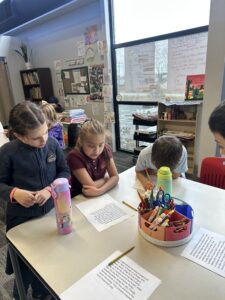

Recently, students have been learning about informational text structures, which are the different ways authors organize nonfiction texts to clearly share information. Understanding these structures helps students become stronger readers by allowing them to recognize how ideas are presented and why an author chose a particular format.
We began by discussing the purpose of informative writing and why authors organize information in specific ways. Students learned that recognizing text structure can help them better understand, summarize, and locate important details in nonfiction texts.
We focused on these informational text structures:
-
Description
-
Compare and Contrast
-
Problem and Solution
-
Sequence
-
Cause and Effect
For each structure, we examined what readers should look for and paid close attention to signal words (such as for example, however, first, because, and as a result) that help identify how the text is organized.
Once students were familiar with each structure, they practiced applying their knowledge by sorting short nonfiction passages about bees into the correct categories. This hands-on activity helped them think critically about how information was presented rather than just what the text was about.
As a whole group, we also explored how the same topic can be written in different ways. Using the familiar topic of brushing your teeth, students helped generate example sentences for each text structure. This activity reinforced the idea that authors make intentional choices when organizing information depending on their purpose.
Next, students will continue to read, analyze, and sort informative texts, gradually working with passages that are more complex and challenging. This will help strengthen their ability to identify text structures independently.
After that, we will begin studying text features commonly found in nonfiction, such as headings, subheadings, captions, tables of contents, and more. Students will learn how these features support understanding and help readers locate information efficiently.