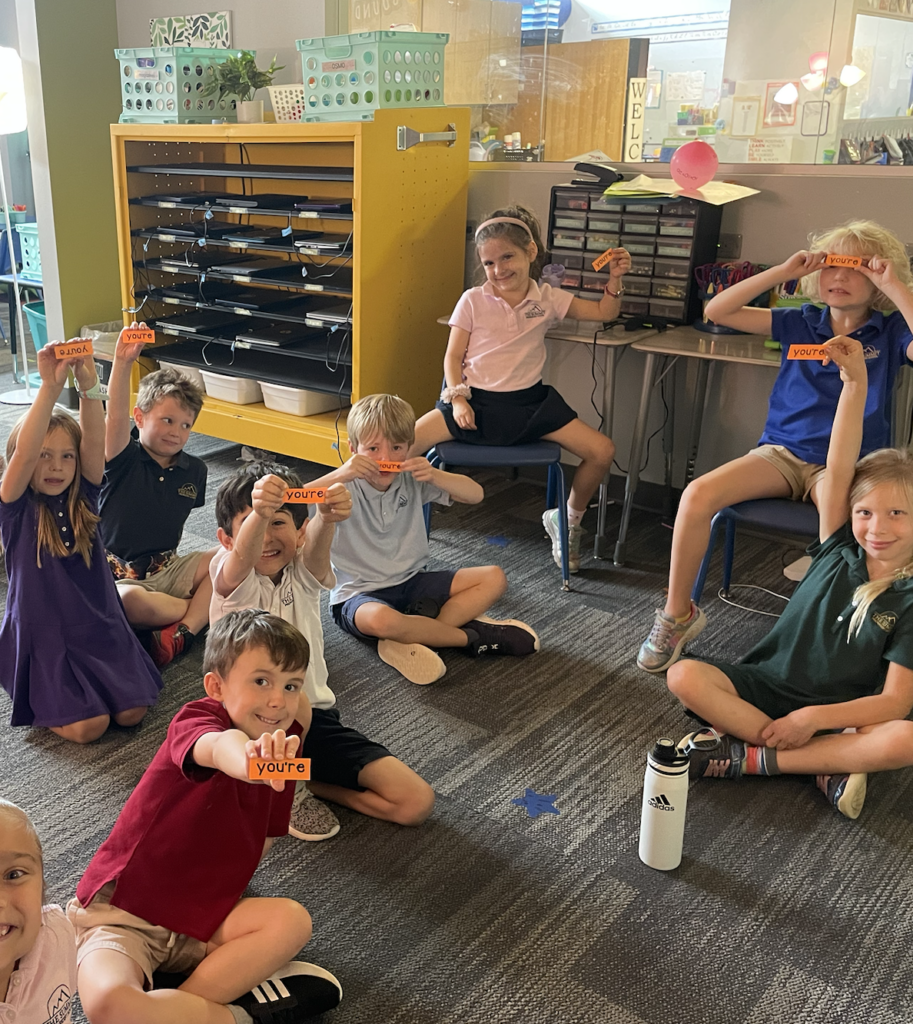

One of this week’s high frequency spelling words might look familiar to first graders and parents! Your was on our list last week AND this week! Last week, first graders became confident in spelling the pronoun your (along with similarly-spelled high frequency words our and you). This week, students are learning how to differentiate between the pronoun your and the contraction you’re!
First graders learned that a homophone is a pair of words that sound the same but are spelled differently and have different meanings. Your and you’re are great examples of this!
Did You Know?
The word homophone is made up of two Greek roots – the prefix homo meaning same and phone meaning related to sound.
During our spelling lesson on Monday, first graders learned that your means belonging to you and that you’re is the contraction for “you are”. They are already familiar with contractions and apostrophes because we have studied them during morning meeting and in texts we have read. Speaking of apostrophes – we discussed that the apostrophe is just as important in the word you’re as the letters are.
This afternoon, we practiced differentiating between your and you’re using a wide variety of examples. Students got two cards, one with each version of the word. Ms. Ursino read a sentence and we discussed which spelling we should use. Then students held up the correct form. When discussing, we thought about if “you are” fit in the sentence in place of your/you’re. For example “You are shirt is blue.” doesn’t make sense! If it did make sense, students held up the you’re card. If there was a noun associated with the word your/you’re, students thought “Does it belong to you?” and if the answer was yes, they held up your! After the first few sentences, first graders didn’t even need the whole-class discussion to help them, and they began independently identifying which version should be used! Check out some of our example sentences below and see if you can identify the correct version!
_____ shirt is blue.
Did you bring _____ backpack today?
_____ a great friend.
Tell _____ mom I said hello.
_____ going to have a birthday soon.
Is that _____ notebook on the table?
If _____ not feeling well, we can stay home.
_____ teacher loves you.
Maddy wants to go to _____ house for dinner.
I can’t believe _____ turning 7!
Can I borrow _____ purple marker?
_____ going to ride home with grandma.
Meet me on _____ sit spot.
Melissa said _____ coming to the party.
Will you take _____ dog to the park?
I forgot my jacket in _____ car.
_____ expecting a letter in the mail.
_____ handwriting is very neat.